Weloveya, or When Cotonou Becomes the Capital of African Nights There is, in the final days of December in Cotonou,…
Weloveya, or When Cotonou Becomes the Capital of African Nights
There is, in the final days of December in Cotonou, a particular intensity. A way for the city to reach toward something greater than itself. The avenues come alive differently, youth floods in, homecomings multiply, diasporas mingle with regulars, and the Esplanade de l’Amazone, a vast open-air theater, transforms into a rallying point for an immense crowd. It is there that Weloveya has found its place. And more than that: its kingdom.
In just a few years, the festival has established itself as one of the continent’s great urban gatherings, to the point of being regarded today as one of the most powerful cultural markers of the year’s end in Africa. It is no longer merely an event. It is a moment. A landmark in the African festive calendar. A stage where a certain idea of contemporary Africa is displayed, heard, and felt: young, connected, ambitious, proud of its sounds, its codes, its unapologetic grandeur.
The convergence point of an Africa in motion
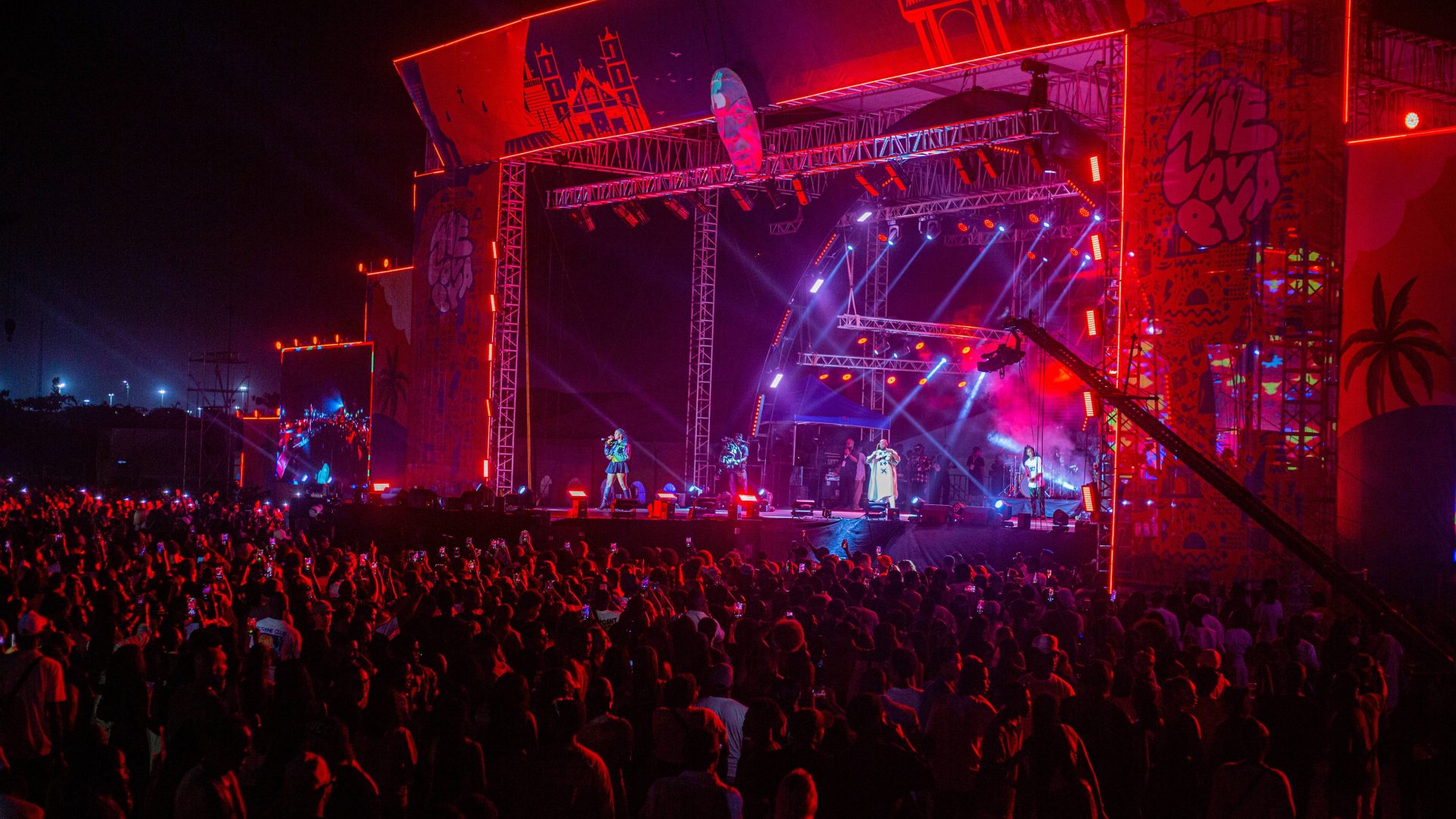
Weloveya was not born great. It became so, edition after edition, by capturing something of its era. First a surge. Then an expectation. Finally, a self-evident truth. Each year’s end, several tens of thousands of festivalgoers converge on the Esplanade de l’Amazone to share far more than a succession of concerts. They come seeking an atmosphere, a collective vibration, a way of inhabiting the city and the night together.
What makes the festival rare is its ability to bring together audiences from very different backgrounds without ever diluting its identity. One encounters Beninese youth, of course, but also visitors from the sub-region, diaspora members returning for the holidays, the curious, the passionate, lovers of great African musical gatherings. All drawn by the same promise: that of a rendezvous where Cotonou speaks to the continent, and where the continent answers back.
A stage built for giants
The power of Weloveya also lies in its programming. For it must now be reckoned with in the geography of major festivals capable of attracting the names that shape the soundtrack of Africa and its diaspora. From Burna Boy to Asake, by way of Wizkid, Rema, or Gims, the lineup alone tells the story of the project’s ambition: to place Cotonou on the circuit of the great capitals of African live performance.
These headliners are not mere prestigious guests. They give the festival its symbolic weight. With them, Weloveya ceases to be a large-scale local event and becomes a continental stage. It welcomes artists who fill stadiums, set platforms ablaze, dictate trends, and accompany the imaginations of an entire generation. Their presence says something precise: the Esplanade de l’Amazone is now a place where the greatest can be expected.
And when these names take the stage, something shifts. The festival takes on another dimension. Music becomes a common language. Choruses travel from one country to another. Bodies respond to one another. Borders dissolve in the movement of a crowd that knows the same songs, shares the same references, and celebrates, for the span of a night, a diffuse but powerful belonging to an expanded African cultural space.
The Esplanade de l’Amazone, a stage worthy of the event
What was needed was a venue capable of absorbing this scale without losing symbolic force. The Esplanade de l’Amazone imposed itself as an obvious choice. Through its dimensions, its centrality, and what it represents in the landscape of Cotonou, it offers the festival more than a setting: a stature.
At the foot of the monument, the celebration takes on a particular depth. It does not float in an anonymous space. It is inscribed in a place charged with meaning, in a city that increasingly asserts its role as a cultural crossroads, in a Benin that is learning to turn its public spaces into stages of influence. Weloveya does not merely occupy the Esplanade; it reveals it in a new light, metamorphosing it into a contemporary agora, vast and vibrant, where spectacle, youth, the city, and the world converge.
More than a festival, a signal
What unfolds at Weloveya goes beyond music. The festival is also an indicator. It reveals Benin’s capacity to host very large gatherings, to produce events of great scope, to offer artists and audiences a setting that is at once popular, ambitious, and perfectly attuned to its time. It tells the story of a country that no longer contents itself with being viewed through its heritage, its history, or its memory, but that also asserts itself as a stage for creation, encounter, and contemporary celebration.
In an Africa where major festivals have become strategic sites of visibility, influence, and attractiveness, Weloveya now occupies a singular place. It participates in this new cultural cartography of the continent, where capitals and major cities no longer distinguish themselves solely through their institutions, but also through their ability to create gatherings that people anticipate, recount, and travel for.
The year-end rendezvous
Perhaps it is there, ultimately, that its most resounding success lies: in having made late December in Cotonou a moment anticipated well beyond Beninese borders. Weloveya has installed a habit, almost a reflex. When the year draws to a close, a part of festive Africa looks toward the Amazone. It knows that something is happening there. Something vast, loud, joyful, and unifying.
At a time when so many festivals struggle to move beyond the status of a one-off event, Weloveya has already crossed a rarer threshold: that of lasting inscription in the collective imagination. It is no longer merely scheduled. It is awaited. It no longer merely fills a stage. It magnetizes a city.
The proof is in the crowd
Each edition provides the demonstration. Tens of thousands of festivalgoers gather there, carried by a shared energy, by the desire to live together a moment that has become emblematic. This crowd is not merely a number. It is the measure of a phenomenon. It speaks of attachment, of the power of attraction, of the trust placed in a rendezvous that has earned its credentials.
Weloveya is today one of those festivals that matter because they succeed in condensing several realities into one: music as a popular force, the city as a backdrop, youth as a driving force, Africa as a horizon. And at the center of this alchemy, the Esplanade de l’Amazone, which each late December becomes the place where the rhythms, bodies, voices, and imaginations of a continent in full assertion come together.